Showing posts with label suede coat. Show all posts

Wednesday, July 1, 2009

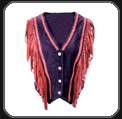
Fashionable waistcoats made up of leather

FAP-LFJ-011

A waistcoat (sometimes called a vest or a vestee in Canada and the US) is a sleeveless upper-body garment worn over a dress shirt and necktie (if applicable) and below a coat as a part of most men's formal wear, and as the third piece of the three-piece male business suit. Once a virtually mandatory article of men's clothing, it has become uncommon in fashionable dress in the English-speaking world, although it has returned to fashion as part of business wear in Germany.

Waistcoats have now[update] become a popular article of clothing amongst the youth of Britain as style symbol Kate Moss and the members of indie band Razor light wear them over casual shirts and jeans for a day-to-day fashionable look. The waistcoat is one of the few pieces of clothing whose origin historians can date precisely. King Charles II of England, Scotland and Ireland introduced the waistcoat as a part of correct dress during the Restoration of the British dominion.

A waistcoat has a full vertical opening in the front which fastens with buttons or snaps. Both single-breasted and double-breasted waistcoats exist, regardless of the formality of dress, but single-breasted ones are more common. In a three piece suit, the cloth used matches the jacket and trousers.

Before wristwatches became popular, gentlemen kept their pocket watches in the front waistcoat pocket, with the watch on a watch chain threaded through a buttonhole. Sometimes an extra hole was made in line with the buttonholes for this use. A bar on the end of the chain held the chain in place to catch it if it were dropped or pulled.

Leather Waistcoats are made of the best quality leather and match the latest styles prevalent in the market. They come in various cuts and designs and are made using premium quality leather that add to their quality. The contemporary designs in waistcoats make them a hit among the fashion conscious men, women and kids of today. These are available in leather varieties such as nubuck, goat suede, cow nappa etc. Inner lining of Leather Waist coats can be of suede, taffeta or velvet. Individual color printed box and logos can also embossed on it, on demand. Crafted out of leathers, which have sensuous texture and are of good material, leather waist coats are available in foreign designs and cuts in colors such as lime, black, brown and the bright shades of red, yellow blue etc leather waistcoats are available in different shapes, styles, and sizes.

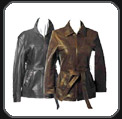
TYPES OF COATS

FLC-002

Frock coat

A frock coat is a man's coat characterized by knee-length skirts all around the base, popular during the Victorian and Edwardian periods. The double-breasted style is sometimes called a Prince Albert (after the consort to Queen Victoria). The frock coat is a fitted, long-sleeved coat with a centre vent at the back, and some features unusual in post-Victorian dress. These include the revers collar and lapels, where the outer edge of the lapel is cut from a separate piece of cloth to the main body, and also a high degree of waist suppression, where the coat's diameter round the waist is much less than round the chest. This is achieved by a high horizontal waist seam with side bodies, which are extra panels of fabric above the waist used to pull in the naturally cylindrical drape. The frock coat was widely worn in much the same situations as modern lounge suits and formalwear, with different variations

Morning coat

A morning coat is a single-breasted coat, the front parts usually meeting at one button in the middle, and curving away gradually into a pair of tails behind, topped by two ornamental buttons on the waist seam. The modern morning coat (or cutaway in American English) is a man's coat worn as the principal item in morning dress. The name derives from morning nineteenth century horseback riding exercise for gentlemen. It was regarded as a casual form of half dress. Gradually it became acceptable as an alternative to the frock coat for formal day wear or full dress. Since the nineteenth century it is normally only seen at weddings, formal baptisms and funerals and, in England, races such as Royal Ascot and the Derby.

Tailcoat

A tailcoat is a coat with the front of the skirt cut away, so as to leave only the rear section of the skirt, known as the tails. The historical reason coats were cut this way was to make it easier for the wearer to ride a horse, but over the years tailcoats of varying types have evolved into forms of formal dress for both day and evening wear. Although there are several different types of tailcoat,

Buff coat

The Buff coat (so-called because of its yellowish color) was an item of leather clothing worn by both the infantry and cavalry during the 17th century, usually worn under armour. It evolved from the leather jerkins worn by soldiers during the Tudor period to a 3/4 length, close-fitting garments with long sleeves and a high collar to protect the neck and arms.

It was made of 3mm-thick suede cowhide and provided protection against swords blunt trauma and possibly long range pistol balls, however as with all armour of the time it was ineffective against musket

Dinner coat

Black tie is a dress code for semi-formal evening events, and is worn to many types of social functions. For a man, the major component is a jacket, known as a dinner coat (British) or tuxedo (Canada and the U.S.), which is usually black but is also seen in midnight blue.

Basque coats

A basque (also known as a torsolette) is an item of women's historical apparel. The term, of French origin, can mean either a long corset or jacket characterized by a close, contoured fit and extending past the waistline over the hips. Probably so called because this fashion of dress came from the Basques, and adopted by the French and then the English

FMC-010

Spencer coats

The Spencer, dating from the 1790's, was originally a woolen outer tail-coat with the tails cut-off. It was worn as a short waist-length, double-breasted, man's jacket over a long-tailed coat as extra covering. In its most authentic and fashionable form it would have been decorated with military medals in a manner